Chapter 7 Dna fingerprinting 1. Radio-active molecules such as 32P or 35S are used to do so.
Dna Fingerprinting Principle Methods Applications
Fundamentals Investigations Chapter 7.

. Dna in forensics 1. As discussed earlier the technique of fingerprinting is used for DNA analysis in forensic tests and paternity tests. Describe how radioactive probes are used in DNA fingerprinting.
Before these probes are used they are tagged with a radioactive substance or a color-inducing chromogenic or fluorescent dye. The fragments underwent autoradiography in which they were exposed to DNA probespieces of synthetic DNA that were made radioactive and that bound to the minisatellites. These places are marked as dark bands when X-ray film is exposed.
DNA probes used in fingerprinting are. It is useful in identifying individuals particularly in forensic sciences. Compare and contrast a VNTR to a radioactive probe.
This pattern is DNA fingerprinting. Chapter 7 DNA Fingerprinting Objectives and Vocabulary Objectives Explain how crime scene evidence is collected for DNA analysis Describe how crime scene evidence is processed to obtain DNA Describe how radioactive probes are used in DNA fingerprinting Explain how. Labelling of probe.
Either radioactive molecule or non- radioactive molecule are used to label the probe. This helps in detecting the matched DNA visually. DNA fingerprinting can answer the question of the relationship to another person quickly and accurately.
DNA fingerprinting is a procedure that shows the hereditary cosmetics of living things. Now these bands when compared with the other known samples will give the final result of the DNA fingerprinting. Describe an example of varying allele frequencies found between two different.
After the hybridization with the radioactive probes the X- ray film is developed form the southern blotting and only the areas where the radioactive probe binds will show up on the film. When x-ray film is exposed to radioactive a pattern of more than 30 dark bands appear on the film where the labelled DNA. Double-stranded probes would not hybridize with DNA fragments present on the membrane and non-radioactive probes can not be detected by autoradiography.
Assemble a virtual DNA fingerprint and use it to identify the culprit in a hypothetical crime. Small bits of minisatellite DNA is tagged with radioactive phosphorus to serve as probes. The x-ray film recorded the pattern of radioactivity on the paper.
In case of the change in gene frequency or genetic. DNA fingerprinting also termed as DNA profiling is a method of isolating and identifying variable elements within the base pair sequence of DNA. The resultant pattern of marks could then be analyzed.
O Explain how crime scene evidence is collected and processed to obtain DNA o Describe how radioactive probes are used in DNA fingerprinting o Explain how DNA evidence is compared for matching o Explain. DNA segments having radioactive isotopes. It is helpful in establishing a link between biological evidence and a suspect.
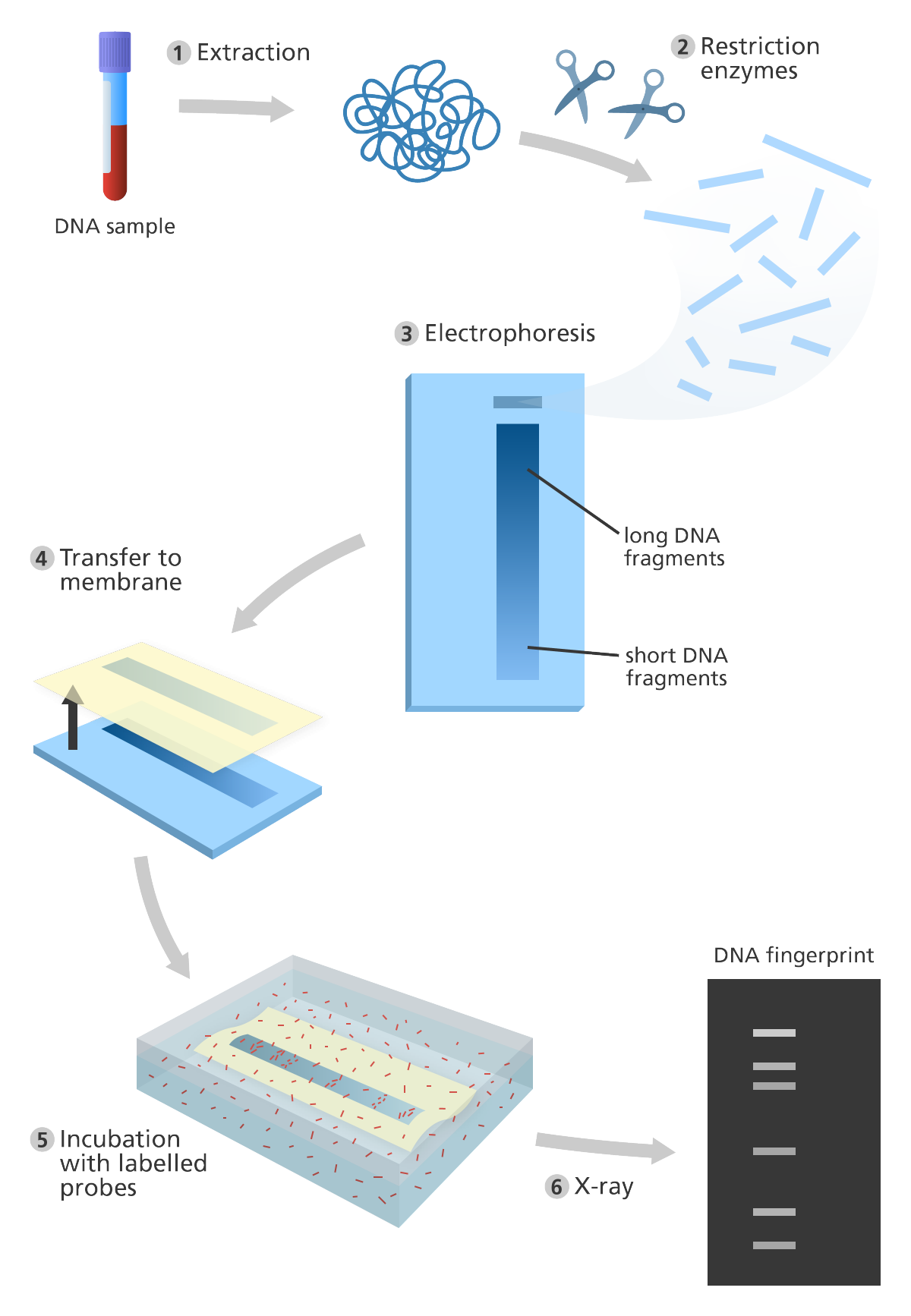
Add radioactive probes so that complementart DNA will bind. This is a technique where an X-ray film is exposed to the nitrocellulose membrane to mark the places where the radioactive DNA probes have bound to the DNA fragments. It is a strategy for finding the distinction between the satellite DNA areas in the genome DNA profiling DNA testing DNA examination Genetic profile DNA distinguishing proof genetic fingerprinting and genetic investigation are a portion of the.
Pattern of DNA fragments of time by examining a persons unique sequence of DNA base pairs also called DNA profiling. In addition to adopted children finding their birth parents or settling paternity suits DNA fingerprinting has been used to establish a relationship in cases of inheritance. One of the important characteristics of the probe is the label attached on its end which makes it different from the DNA primers.
Enzymes cut apart the DNA in specific places forming different sized fragments 3. Fundamentals Investigations Chapter 71 Chapter 7 DNA Fingerprinting By the end of this chapter you will be able to. DNA fingerprinting uses single-stranded radioactive probes which are washed over the nylon surface to allow their joining to any DNA fragments of the same composition thereby matching different DNA samples.
Correct option is C Solve any question of Molecular Basis of Inheritance with-Patterns of problems. Preparing DNA Samples for Fingerprinting 1. A piece of X-ray film was then exposed to the fragments and a dark mark was produced at any point where a radioactive probe had become attached.
DNA is separated within an agarose gel 4. Describe how radioactive probes are used in DNA fingerprinting explain how DNA evidence is compared for matching explain how to use DNA fingerprinting to identify DNA from a parent child other relative or a nonrelated individual Since the 1980s DNA has been used to investigate. If given a specific VNTR to be able to determine what radioactive probe would be needed to help identify the VNTR _____ 34.
Chapter 7 DNA Fingerprinting Forensic Science 2. An electric current is passed through the gel separating the fragments by size 12 Forensic Science. In a dark room nitrocellulose paper is placed against a piece of x-ray film.
Cut DNA and use the same restriction enzyme on it. DNA is mixed with special enzymes 2. In the last 15 years DNA has played.
Process of electrophoresis will separate lengths. Apart from these two fields it is also used in determining the frequency of a particular gene in a population which gives rise to diversity. A molecule labeled with a radioactive isotope dye or enzyme that is used to locate a particular sequence or gene on a DNA molecule.
DNA Fingerprinting Steps Extracting DNA from Cells PCR Amplification Optional Treatment with Restriction Enzymes Gel Electrophoresis Transfer onto Southern Blot Treatment with Radioactive Probe X-Ray Film Exposure. The probes only bind to sections of DNA that are complementary to them in this case they bind to the genomes minisatellites. Highly sensitive electron microscope.
DNA fingerprinting can also be used to identify a decomposing body. This DNA probe is a single stranded DNA having a sequence complementary to the desired sequence the DNA to be investigated like DNA found at the crime site etc. This is done by putting nylon membrane into a bath containing probes probes are short pieces of single standard complementary DNA tagged with radioactivity that bind to a specific chain of DNA VNTR sequences according to base-pairing rule.
The bands to which the radioactive probes have been hybridized are detected through autoradiography.

Dna Fingerprinting Analysis With Three Radioactive P 32 Labelled Download Scientific Diagram
Dna Fingerprinting Qforquestions

Genetic Fingerprinting S Cool The Revision Website



0 Comments